Monday, March 9, 2009

66) Strange Wilderness (2008)


66) Strange Wilderness (2008) Dir: Fred Wolf Date Released: February 2008 Date Seen: March 8th, 2009 Rating: 2/5

I cannot nor will I defend the moderate but sufficient amount of yuks I got from this hideous mess of a stoner comedy. After this sometimes funny stinker, Harold and Kumar looks positively ambitious.

Saturday, March 7, 2009

65) Watchmen (2009)


65) Watchmen (2009) Dir: Zack Snyder Date Released: March 2009 Date Seen: March 6th, 2009 Rating: 2.75/5

The long and short of the good/bad news about Zack Snyder’s much-anticipated and even more dreaded adaptation of Alan Moore and David Gibbons’ Watchmen is that there’s more good than bad in it, but not by much. Attempting to adapt the modernist monolith was sheer heedless ambition on Snyder’s part and while the film’s altered ending still packs a punch, the task of keeping all of the original story’s balls in the air was clearly too much for him. Trying to satisfy both fans and new-comers alike, his tendency to err on the side of strict adaptation has once again backfired (see Robert Rodriguez’s Sin City for another slavishly dull adaptation), leaving much of the film a passionless tracing of the original material and the rest a pointless but not infrequently satisfying revival.

To give credit where credit is due, Snyder’s adaptation does everything it can to fit everything it can into its 2 hour 43 minute runtime. While Watchmen would almost certainly have made a better TV show or mini-series event, the film is as competent an adaptation as it could’ve been for a film with little ambition other than sticking like rubber cement to the comic.

Therein lies the film’s biggest self-imposed hurdle. In trying to be a faithful representation, it bogs itself down with techniques that only really work in comics. Hearing Rorschach (Jackie Earle Haley, looking like Johnny Rotten in his Walter Kovacs make-up) strain out his journal entries doesn't sound right, which is partly Haley’s fault but mostly the fact that the character’s warped logic was never meant to be read objectively aloud. The preposterousness of the excessive gravel in Haley’s voice, which normally works in his favor during dialogue, buries his words’ urgency. It sounds like something you’d hear at a bad poetry slam instead of a Hammett-esque paranoid screed.

What’s more problematic however is how the flashbacks in the story really wear on the viewers’ nerves after a while thanks to both their bulk and how, unlike the comic, they're forced to be shown in a fixed linear sequence. While the comic broke up its action into fluid asides and interludes, Snyder’s film attempts to tie the film’s events together into a narrative whose flashbacks are not only readily discernible from the present but also have a direct, rather than strongly implied, correlative link with events in the past. This is the peril of a film that has to tell a coherent story out of a jigsaw plot that was never meant to be digested all in one sitting.

Snyder’s film also woefully insists on an aesthetic kinship with its pulpy predecessor. Sometimes he succeeds, like in the stylistic references to the EC Comics that left an indelible impression on Gibbons’ style. Still, the undergirding idea of making a film look like a comic is particularly lame when it comes to the way Snyder constantly presents traumatic encounters and action scenes as slow-motion snapshots. That technique feels especially out of place in Watchmen considering how the comic defies the romanticism that comes with nostalgia, specifically the fetishization of the characters' fond memories. It's also rather trying considering how often the technique is used. 

Again, within the constraints of that kind of mentality, the film is engaging enough—the Dr. Manhattan (Billy Crudup, working wonders with the Master Card voice) backstory is especially affecting because of how effectively Crudup’s passionless voiceover undermines the scene’s slick and effectively portentous look. In the long run however that’s not saying much.

Additional notes:

-Disappointed by how Haley delivered my favorite line in the comic—“You people don’t seem to understand. I’m not trapped in here with you. You’re trapped in here with me.” It wasn’t a desperate howl but rather a Bale-as-Batman type grumble. If I were a prisoner he were taunting, I’d yell back, “WHAT?! WE CAN’T HEAR YOU!”

-The sex scene suggests an awesomely inappropriate sense of humor at work and while I get that’s just because Snyder loves The Comedian's “It’s all a joke” mentality a little too much, that’s not a valid excuse for adding a superfluous, jokey, Heavy Metal-esque scene of copulation.

-Patrick Wilson was mostly good but he disappointed me with some of his lines; I still think he’s only a so-so performer but he has his moments here and he was pretty decent in Little Children, too. I most strongly object to his lack of a gut in the film considering how integral that is to understanding that the character has let himself go. As it is, he looks like he could have leapt back into action at a whim, which really doesn’t make much sense.

-Carla Gugino was terrific as was Billy Crudup and Matthew Goode. Jeffrey Dean Morgan joins Haley and Wilson in the so-so pile.

Thursday, March 5, 2009

ISF: How Men Propose and A House Divided (1913)

ISF: How Men Propose (1913) Dir: Lois Weber and Alice Guy-Blaché Date Seen: March 5th, 2009 
With its portrayal of a woman courting three men for an article she’s writing, I couldn’t help but think of the film having an undergirding logic suggestive of a weird precursor of a post-feminist attitude. But then again I’m not sure. Is it really an example of vamping up one’s sex to equalize gender inequality/emphasize the impenetrability of ‘women’ as a category? My knowledge of feminist theory is clearly wanting.

ISF: A House Divided (1913) Dir: Alice Guy-Blaché Date Seen: March 5th, 2009 
I find the comic interaction through the cue cards and intertitles to be a very fun and perceptive use of the uniquely cinematic ability to transition between a close-up text-object and the people reacting to it. Other than that, I have nothing to say; outdated battles of the sexes are only so interesting.

Note: couldn't find pictures for either film. Sowwy.

Wednesday, March 4, 2009

64) 13B (2008)


64) 13B (2008) Dir: Vikram Kumar Date Released: March 2009 Date Seen: March 4th, 2009 Rating: 2.75/5

Via my twitter: “Despite it being as precious and absurd as all get-out, 13B was actually a lot of fun. I'll dream of the last musical number tonight.” See my forthcoming review for the New York Press for more juicy details.

Tuesday, March 3, 2009

63) Two Lovers (2008)


63) Two Lovers (2008) Dir: James Gray Date Released: February 2009 Date Seen: March 3rd, 2009 Rating: 4/5
 -“You know what I realized?”
-“What?”
-“I never really saw you.”
 -“I never saw you, either. I could feel you, you know. I could really feel you.”
What’s striking about the way director/co-writer James Gray films Leonard (Joaquin Phoenix), his titular two lovers (Gwyneth Paltrow and Vinessa Shaw) and his surrounding community (including Isabella Rossellini and Moni Moshonov) is the way the camera is both distantly voyeuristic and uncomfortably familiar. It is as if we are watching Leonard through the eyes of an invisible and hence powerless friend, one not satisfied with mere detached surveillance. We are allowed to get close enough to embrace him, but in a split-second, we are pushed back for the sake of simultaneously respecting and re-enforcing the distance between us and him. It’s almost as if we’re family.

That kind of intimacy is something Gray sought to envelop the feuding brothers in We Own the Night (2007), which featured equally laudatory performances from Phoenix and his co-stars. Here the empathic sense of frailty and tragic optimism that the film’s stellar cast radiates is fully embraced by Gray’s technique—and a better screenplay doesn’t hurt either. The film’s finale, especially Leonard’s farewell to his mother, is full of such prickly poignance that it oozes with a desperate kind of melancholy. It suffocates you with its warmth.

62) Street Fighter (1994)


62) Street Fighter (1994) Dir: Steven de Souza Date Released: December 1994 Date Seen: March 2nd, 2009 Rating: 3.5/5

It’s easy to see why writer/director Steven de Souza’s Street Fighter might have been scuttled off to a January or February release. But. What’s even more incredible than seeing that it was released on December 23rd—early Christmas present?—is that the film is actually fun. 

Unfortunately, my affection for this film is an apologist’s kind of love, the kind whose defense is predicated on having grown up playing the video games that the movie is based on (though the credits credit only Street Fighter II, fans will recognize some later characters, like D.J. and Tomahawk). What I can semi-objectively offer is that while the film can be taken as a big in joke with fans, it does exactly what a Street Fighter movie should: provide a silly, light and energetic plot full of fights, cameos and flashy effects. Nostalgia be damned, it’s a goodish movie! Leave Street Fighter alone!

Still, as long as I’m admitting that I’m watching this film to satisfy the 10 year-old in me, I have to say that it’s hard to watch the film without looking at either of the two main character actors in the film retrospectively. As Col. Guile, Jean Claude Van Damme doesn’t get an opportunity to flex his famous muscles but then again, the film is yet another example of why his plea for playing at peace in JCVD (2008) seems so silly. He’s a member of the AN, a UN stand-in but when given the chance to put his arms down, he voluntarily chooses to kick ass instead. He’s got such laughably bad punny lines that if one weren’t watching the rest of the film, you might easily think that de Souza had it out for Van Damme.

In the same vein, it’s tough to suppress a groan or five when you’re watching poor, sickly Raul Julia shoot lightning out of his hands and zoom around on electro-magnetic boots. Seeing him taunt Van Damme is one thing but watching him get the snot kicked out of him knowing that he was about as sturdy as a toothpick at the time and had to wear a wire suit to fill out Bison’s signature red uniform—whose designer is specially credited in the beginning!—I had to suck in my teeth and chuckle. Then again, rewatching the film for the first time in its entirety, I can’t help but reject the old joke about the film being so bad it killed him—he gets in some good lines like when he tells Chun-Li, “For you, the day Bison graced your village was the most important day in your life. For me, it was Tuesday.” Honestly, that Julia stayed alive after Overdrawn at the Memory Bank  (1983) is the real miracle. Accentuate the positive, people.

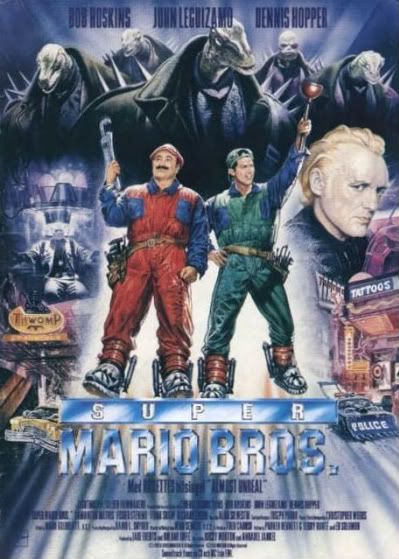
Oh and while I'm on the subject: neat poster, huh?

Monday, March 2, 2009

61) Turkey Shoot (1982)


61) Turkey Shoot (1982) Dir: Brian Trenchard-Smith Date Released: October 1983 Date Seen: March 1st, 2009 Rating: 3.5/5

As a Battle Royale-esque exploitation golden not-so-oldie, Turkey Shoot succeeds within its self-imposed limitations at critiquing Thatcherite strict “order”-based logic. To my mind, there’s no more perverse way to upend her regime's justly demonized mentality than with a movie that's as alternately organized and spazzy as  this one, being a film about rich blueboods who hunt proles with everything from exploding arrows to a manimal. While it understandably won’t strike a chord with anyone looking for a serious political critique (unless of course you think Ilsa the She-wolf of the SS is a radical revisionist challenge), as a fun little Corman-esque splatterfest with ample amounts of camp and moderately artistic camerawork, it hits the spot.